
«International Law is no longer just there»: why geopolitics has become a strategy question
Geopolitical shocks are developing faster than the legal frameworks underpinning international business can adapt. Following the launch of the Center for Geopolitics and Corporate Strategy at the University of St.Gallen, co-founder Thomas Burri explains why international law can no longer be treated as background infrastructure — and what companies can do about it.
Interview by Viktoriya Zakrevskaya
Companies have discussed geopolitical risk for years. What has changed now that makes it a corporate strategy question rather than simply a risk-management issue?
What has changed is the pace and magnitude of events. Major conflicts and geopolitical shocks can develop within days or weeks, requiring companies to adapt very quickly.
Law — and international law in particular — traditionally develops over years or even decades. That creates a fundamental tension. The environment is changing faster than the legal system can respond, while companies must make decisions before the rules or their interpretation have settled.
Geopolitics therefore cannot be treated only as an external risk to be monitored. It affects the assumptions on which corporate strategy, investment and international operations are based.
For an internationally active company, where is the line between a legal problem and a geopolitical problem?
The distinction remains useful analytically. You need to understand whether you are dealing with a legal obligation, a political development or another type of risk.
In practice, however, the borders are becoming less clear. Legal obligations, political expectations, moral imperatives and basic commercial judgement increasingly overlap.
International lawyers are in an interesting position because international law has never been completely separate from politics. What was sometimes seen as a weakness — the difficulty of separating law from political power — may now become a strength. International lawyers are accustomed to thinking about both dimensions.
International law used to be something companies could largely take for granted. States concluded treaties, established rules and created a degree of confidence that international trade, investment and transportation would continue to function according to a recognised framework.
That assumption is becoming less reliable. International law is no longer simply “there” in the background. Companies must now ask what legal fragmentation, selective enforcement or the weakening of international institutions could mean for their operations. They must also consider whether they can contribute to maintaining the systems on which international business depends.
This goes beyond conventional compliance. It includes scenario planning, strategic legal analysis and a broader understanding of how political and legal developments interact.
«International law is no longer simply part of the background. It has become part of the strategic environment in which companies operate. »
– Thomas Burri
Is regulatory fragmentation itself becoming a geopolitical factor, particularly in areas such as artificial intelligence?
Yes, although fragmentation is not entirely new. What is striking in artificial intelligence is the combination of different regulatory approaches with the extraordinary speed of technological development.
Europe has attempted to create a comprehensive regulatory framework. Other jurisdictions have followed different models and priorities. Meanwhile, the technology continues to produce new applications and risks that the existing rules may not fully anticipate.
This leaves companies with considerable uncertainty: not only about what they must do to comply, but also about whether compliance with one regulatory framework is sufficient to address the wider technological and societal risks.
Calls for global standards, pauses or restrictions are understandable. The difficulty is implementation. If even one major actor does not follow an agreement, the arrangement may become ineffective. Once again, we encounter a collective-action problem.
Your Grand Challenge project on the EU AI Act received the HSG Impact Award. What made that work relevant beyond an academic setting?
Research should connect more closely with practice. This does not diminish the value of fundamental academic work, but universities also need to engage seriously with real-world problems.
That was the idea behind the Grand Challenge: to bring practitioners and academics together and examine whether a major piece of legislation could actually work in practice — how it would be implemented, whether its requirements were feasible and where the unresolved problems remained.
The Grand Challenge demonstrated what becomes possible when academic rigour and practical experience are brought to bear on a concrete problem. That is also the ambition of the Center for Geopolitics and Corporate Strategy: to develop research that is tested against real-world needs and produces insights that decision-makers can use. The aim is not to choose between theory and practice, but to make each more rigorous and more relevant through the other.
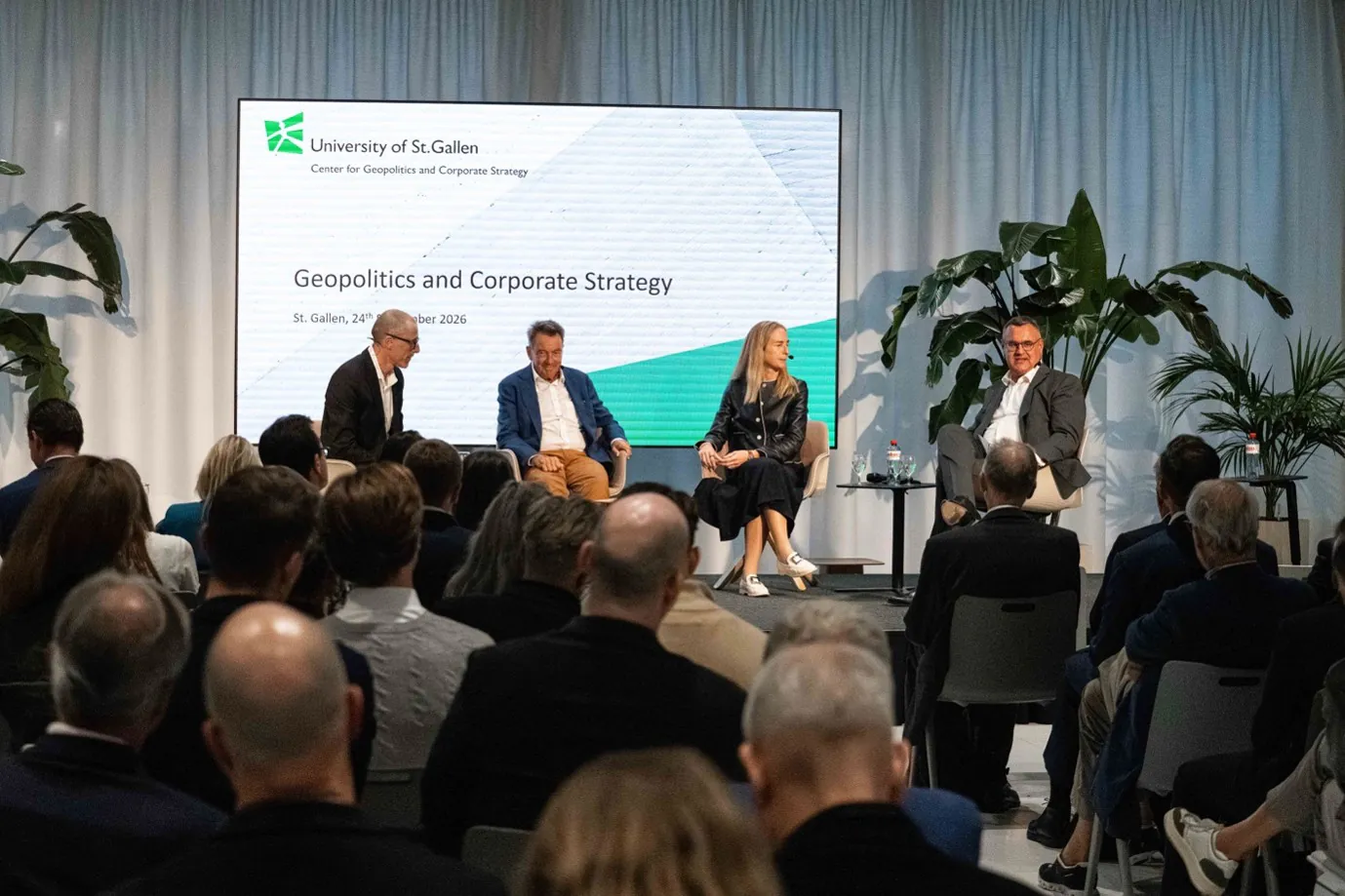
Photo: Leon Olbrecht. // Opening of the Center for Geopolitics and Corporate Strategy, SQUARE (St. Gallen), October 2026. Left to right: Thomas Burri (HSG), Peter Maurer (former ICRC), Alison Martin (Zurich Insurance), Christoph Lechner (HSG)
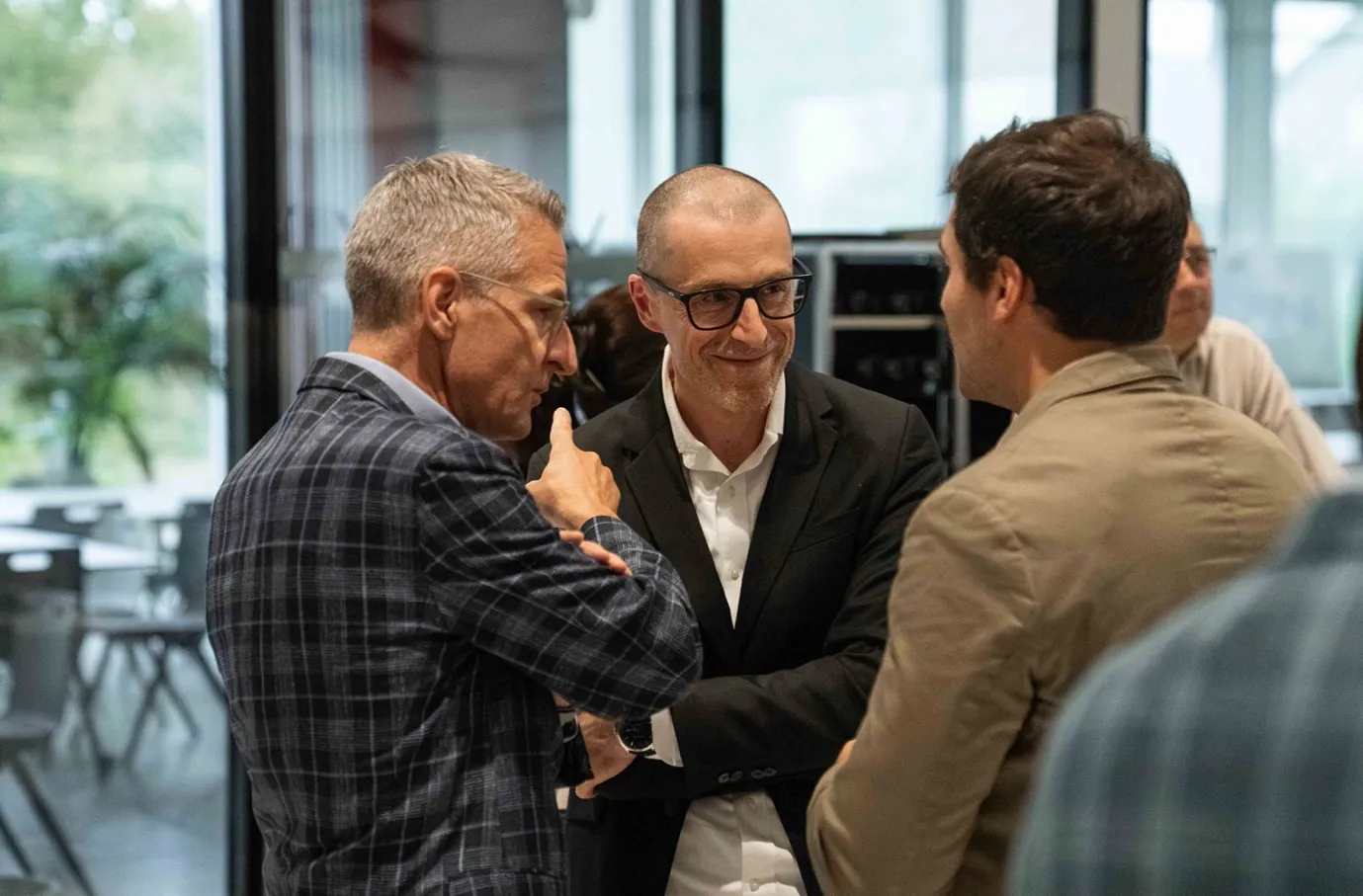
Photo: Leon Olbrecht. // Thomas Burri with guests at the opening of the Center for Geopolitics and Corporate Strategy, SQUARE (St. Gallen), October 2026.